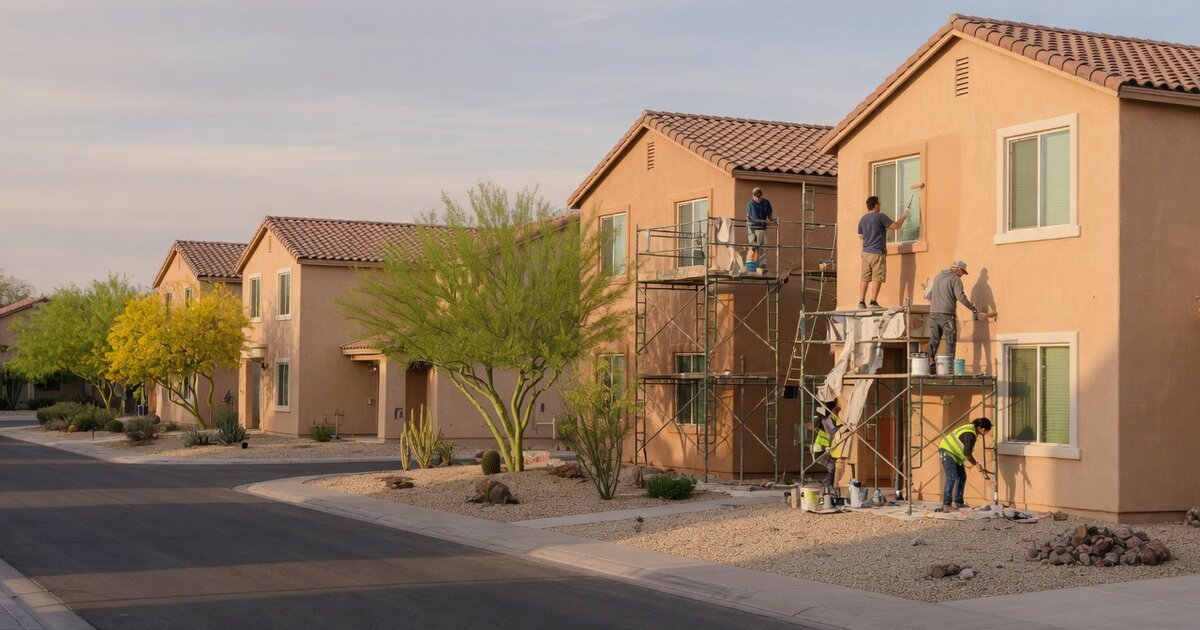
A multi-building HOA cannot treat an exterior repaint like a single commercial wall. The association has more elevations than one crew can finish before the weather changes, residents live against the work, and a color that looks right on the first building has to match the last one months later. In the low desert, the useful season is the dry stretch after the monsoon and before the walls are too hot to coat. Boards that try to paint through that whole calendar, one complaint at a time, finish the year with half the community in a new color and the other half waiting on a special assessment.
This case study is the sequence, not a score from one community. It is how a Southwest board gets a multi-building exterior repaint through one season when the reserve study will not fund a second year of mobilization.
Quick Answer
Finish a multi-building HOA exterior repaint in one season by surveying every elevation before bidding, approving color and sheen on a full-scale mockup, and painting in written clusters. Hold the crew when the wall is outside the coating’s temperature or moisture limits. Close each cluster — punch list, adhesion note, and a resident walk — before the next cluster starts.
Key Takeaways
| Decision | What to lock before work starts |
|---|---|
| Season | The local dry window, not a calendar that ignores monsoon or freeze-thaw. |
| Scope | A building-by-building survey, including repairs, before anyone prices the work. |
| Color | One approved mockup, one product line, and a batch record for every cluster. |
| Sequence | Clusters written down, with a stop rule for heat, rain, and dust. |
| Closeout | Each cluster accepted before the crew moves, so the last building matches the first. |
One-Season Sequence
The season is the constraint
A one-season repaint is a weather plan with buildings attached to it. In the Phoenix area, the National Weather Service dates monsoon season from June 15 through September 30. Storms in that window wet stucco, drop dust, and leave walls that look dry and are not. The practical coating window for low-desert stucco is the drier months on either side of that season, and only during the hours when the wall itself is inside the product’s limits. A data sheet that allows application between 50°F and 90°F surface temperature is describing the wall, not the air. A south or west elevation in May can be outside that range before lunch.
Higher communities do not inherit the Phoenix calendar. Flagstaff, Santa Fe, and the Colorado Front Range trade monsoon moisture for freeze-thaw and a shorter warm season. The board’s job is to name the local window in the contract, including the hours and the conditions that stop work, before the first cluster is scheduled. The HOA painting planning guide is where that window gets funded and approved. This case study is where it gets spent.
Survey every elevation before the bid
Pricing a community from a drive-by produces the change orders that blow a one-season schedule. The survey walks every building and records substrate, existing coating, cracks, failed caulk, wood rot, exposed metal, and the access that a crew will actually use: gates, balcony rails, carports, and slopes where a lift will not sit. Stucco cracks and delamination are repaired before coating, not painted over. The repair method belongs in the scope, using the same judgment as a commercial stucco repair and recoat.
The bid package is that survey, not a lump sum for “paint the community.” Every bidder prices the same repairs, the same number of coats, and the same clusters. If reserves will not cover the full survey scope, the board cuts whole clusters from this season in a recorded vote. It does not ask the contractor to “make it work” by skipping preparation on the buildings that remain. Skipped preparation is how a one-season repaint becomes a two-year warranty claim.
Governing documents decide who is allowed to make that cut. Some associations own the exterior. Others only enforce a standard while owners paint their own walls. The HOA legal requirements for exterior maintenance settle that question before the survey is commissioned, so the board is not bidding work it has no authority to perform.
Lock color on a wall, not on a chip
A fan deck is not a mockup. Southwest light, textured stucco, and a different sheen will move a color far enough that the second cluster looks like a different community. The board approves one full-scale sample on a representative wall: same substrate, same preparation, same product, same sheen, viewed in morning and afternoon light. That sample stays up until the last cluster is accepted. It is the reference when a resident says the new building does not match the first.
The contract names the product line and requires a batch record per cluster. Crews do not “get close” with a leftover color from another job. If a batch change is unavoidable, the new batch is brushed out against the mockup and accepted in writing before it goes on a street-facing wall. Sheen is part of the approval. Eggshell on one building and flat on the next reads as two colors even when the formula matches.
Phase by cluster, and close each one
The sequence is a map, not a reaction to the loudest street. Group buildings that share access, color, and exposure, and finish that group before opening the next. A cluster is small enough to complete inside a weather window of a few weeks, including drying time and a punch walk. Painting three streets halfway leaves the association with no finished area to show and no clean place to stop if a storm week arrives.
Each cluster closes on paper:
- Preparation and repairs match the survey for those buildings.
- Film build and the number of coats match the specification.
- An adhesion check, by the method the manufacturer names, is recorded. ASTM International publishes the common field methods. The contract should name which one, and the pass result, instead of leaving “it looks stuck” to the punch walk.
- The resident walk for that cluster is done while the crew is still mobilized.
Then the crew moves. Starting the next cluster early, because the lift is already on site, is how color and punch items drift. The same discipline shows up in multi-family repainting that keeps occupants in place: the schedule protects the people in the building, and the work is finished in a defined zone before the zone changes.
Access is part of the cluster plan. Multi-story condo buildings need lifts or scaffold, and fall protection is an OSHA requirement for the crew, not a courtesy. Balcony rails, satellite dishes, and owner-installed shade screens are photographed before the cluster starts so the punch list can tell a pre-existing condition from damage. Vehicles and patio furniture move on the day the cluster notice says they move, not when the sprayer is already mixed.
Stop when the wall is outside the product
A one-season schedule that cannot stop is not a schedule. The contract gives the contractor, and the board’s representative, the duty to hold application when any of these are true:
- Surface temperature or air temperature is outside the data sheet.
- The wall is wet, or it was rained on and has not dried through. Stucco holds water after the surface looks pale.
- Wind is carrying dust onto wet film. A monsoon outflow can do this with no rain at the site.
- Dew, shade, and substrate temperature say the film will not cure before night moisture.
Held days are not a failure of the phasing plan. They are the plan working. Build them into the season as float, cluster by cluster, instead of promising a finish date that assumes every afternoon is paintable. If the float is used up before the last cluster, the board stops at the last closed cluster and schedules the rest in the next window. An incomplete cluster left “finished enough” for a board meeting is the patch residents see all year.
Tell residents which week is theirs
Community-wide notices that say “painting this fall” produce daily calls and cars that do not move. Each cluster gets a notice with the buildings included, the week work is expected, what owners must move, where vehicles go, and who to call. A second notice goes out when a weather hold moves that week. The HOA community painting guide covers the broader communication program. The one-season version of it is narrower: people need the week their own wall is in the sequence.
Keep the notice matched to the map. If cluster three slips two weeks, do not leave cluster four’s notice in place. Residents forgive weather. They do not forgive a crew that arrives on a day the association said would be quiet, or a quiet day when they stayed home to move a car.
Copy the sequence, not a single community’s numbers
No two associations have the same building count, reserve balance, or exposure. A figure from another community’s repaint — square footage, price per building, or how many days a crew “usually” needs — is not a specification. Use this sequence on the association’s own survey:
- Confirm, from the governing documents, that the association may paint the exteriors it intends to paint.
- Name the local season and the stop rules in the request for bids.
- Survey every elevation and bid the repairs with the coating.
- Approve color and sheen on a wall that will remain visible until closeout.
- Paint and accept one cluster at a time, and stop at the last accepted cluster if the season runs out.
That is the whole method. The communities that finish in one season are the ones that would rather deliver six closed clusters than twelve buildings that were started.
Facility Manager Checklist
- Name the season in the contract. Use the local dry window and the product’s surface-temperature and moisture limits, not a hope that summer afternoons will cooperate.
- Survey before you bid. Record substrate, repairs, and access for every building, and make every bidder price that scope.
- Approve a full-scale mockup. Lock product, color, and sheen on a real wall, and keep a batch record for each cluster.
- Write the cluster map. Finish and accept one group of buildings before opening the next.
- Give weather the authority to stop work. Held days are scheduled float. An unfinished cluster waits for the next window.
- Notice the affected buildings. Tell owners the week, what to move, and when a hold changes the date.
Frequently Asked Questions
Can an HOA repaint every building in one season?
Only if the survey, the crew, and the local weather window agree. Many communities can finish a defined set of clusters in one dry season. Promising every building, with no float for heat or rain, is how the work spills into a second mobilization. Cut whole clusters before bidding if the reserve study will not cover the surveyed scope.
What should stop exterior painting on a desert HOA?
Stop when the wall is outside the coating data sheet: too hot, too cold, still wet from rain, or in blowing dust. A surface that looks dry can still hold monsoon moisture. Held days belong in the schedule. Painting through them is what makes a new coating fail on the west elevations first.
How do you keep the color the same from the first building to the last?
Approve one full-scale mockup on the community’s own stucco, in the sheen you intend to use, and require the same product line plus a batch record on every cluster. Check a new batch against that mockup before it goes on a street-facing wall. A color chip will not catch the shift.
Standards & Sources
- National Weather Service, Phoenix — monsoon season dated June 15 through September 30 for the Phoenix forecast area
- ASTM International — field adhesion test methods to name in the specification
- OSHA — fall protection for lifts and scaffold on multi-story buildings