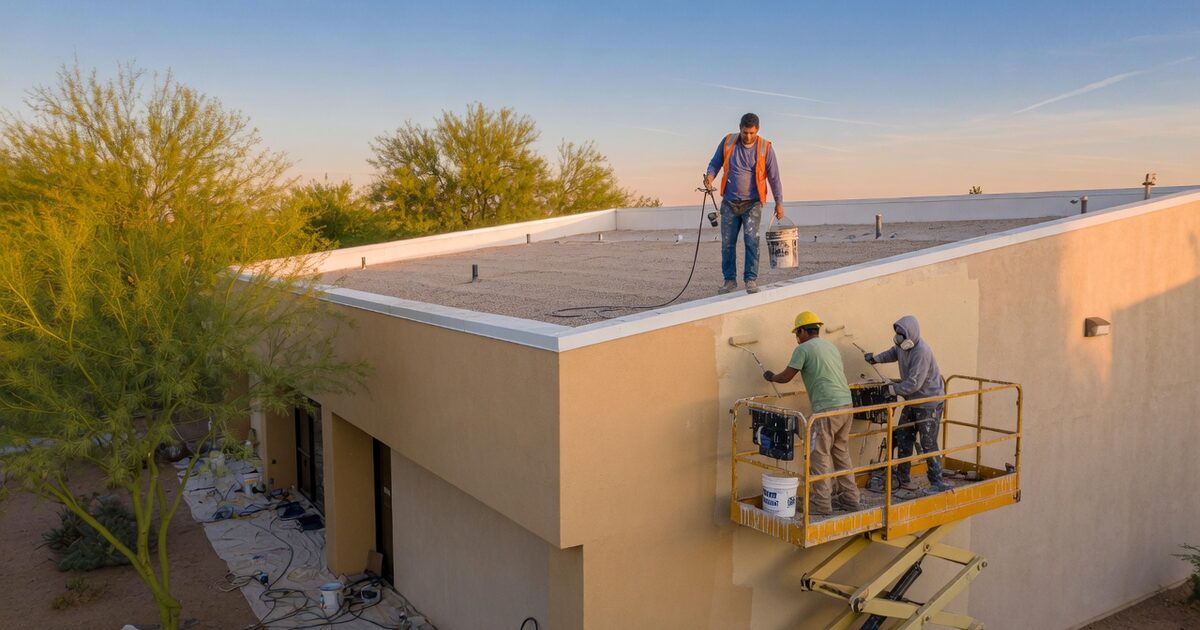
The mid-year 2026 note asked facility managers to buy coating work on documentation and performance, not on a product story. That advice still holds. What changes for 2027 is the paperwork a serious specification now has to name: the local VOC limit in grams per liter, an aged cool-roof rating when the roof is in scope, and a crew plan that says who records preparation and weather. Market-research firms do not agree on the size of the architectural coatings business. A capital plan should not pretend they do.
This outlook is the successor to mid-year 2026 coating industry trends. It is written for the person who has to approve a repaint, a reroof coating, or a reserve line, not for someone shopping a growth forecast.
Quick Answer
For 2027, specify the coating work you can inspect. Treat published market forecasts as background, not a budget. Require the VOC limit that applies at the job site, tested rather than marketed. Where a roof coating is used for heat rejection, require a Cool Roof Rating Council aged solar reflectance and thermal emittance, not an initial number from a brochure. And buy a crew, human or hybrid, that can document prep, film build, and weather holds.
Key Takeaways
| Decision | What is actually shifting | What belongs in the spec |
|---|---|---|
| Market size | Published forecasts disagree by a wide margin | No CAGR, no “the industry will be worth” line |
| Demand | Manufacturers describe renovation, not a new-build boom | Price the buildings you have, including repairs |
| VOC | Limits are local and category-specific | Grams per liter for the category, at the address |
| Roofs | California’s 2025 energy code raised the reference point | CRRC aged reflectance and emittance, or SRI |
| Labor | Crews are tight, so downtime is expensive | Who records prep, thickness, and weather stops |
What to name in a 2027 specification
Do not budget from a market forecast
Search the phrase “architectural coatings market” and you will find several 2026-to-2031 forecasts. They do not match. One house’s starting number is not another’s, and the gap is large enough that averaging them would still be a guess. Those reports are sold to manufacturers and investors. They are not a scope of work for a school, a plant, or an HOA.
Use them, if at all, as a hint about what suppliers are being told to sell: lower-emitting products, roof coatings with a published reflectance, and systems that claim to need fewer labor hours. Then write the specification from the building. The coating selection guide is the place to match chemistry to exposure. This outlook is the place to decide which claims are allowed into the bid.
The work in front of you is renovation
In a January 2026 Coatings World survey, AkzoNobel described a global slowdown in new construction and a shift toward renovation and refurbishment. The same comments tied labor shortages to demand for products that shorten downtime, and called the outlook cautiously optimistic. Sto Corp. told the same reporter to expect moderate 2026 growth from renovation, construction activity, and product changes. Dennis Karnstein, president of Pittsburgh Paints, said in that piece that mild growth was beginning and that he expected it to pick up in the second half of 2026 and accelerate into 2027 and 2028, after a long decline that followed the pandemic remodeling surge.
That is a set of manufacturer readings. It is useful because it matches what facility teams already see: the building exists, the coating is tired, and the crew has to work around occupants. It is not useful as a price index. Bid the repairs the survey finds. Do not add a percentage because an executive said the cycle is turning.
For a Southwest owner, renovation also means the substrate is the project. Stucco cracks, failed sealant, and a roof membrane that has chalked are not a color change. If the specification skips them, the new coating fails on the same elevations the old one did, and the “2027 system” gets the blame.
Name the VOC limit in grams per liter
“Low-VOC” is not a limit. California’s Air Resources Board Suggested Control Measure has listed flat architectural coatings at 50 grams per liter, VOC regulatory, for years. District rules still differ for nonflat coatings, industrial maintenance coatings, roof coatings, and colorants. A gallon that is legal to sell in one air district can miss the category limit in another, and thinning on site can push a compliant product over the line.
The 2027 specification should say:
- The air district, or the adopted rule, that applies at the building.
- The coating category, because a roof coating and a flat wall paint are not the same row in the table.
- The maximum VOC regulatory content in grams per liter, excluding water and exempt compounds, at the manufacturer’s maximum thinning.
- The test the submittal relies on. EPA Method 24 is the federal method for volatile content of coatings. Ask for that result, or for the formulation data the manufacturer will stand behind against it.
Our VOC regulations note walks through how those rules sit next to performance. The outlook addition is narrower: if the submittal does not show a number and a category, it is not a 2027 submittal. A brochure that says “sustainable” or “zero” without the grams-per-liter line does not meet it. Colorant counts. A tint base that meets the limit and a colorant that does not is a different product once it is mixed.
Ask for the aged roof rating, not the fresh one
California’s 2025 Building Energy Efficiency Standards took effect on January 1, 2026. For new nonresidential low-slope roofs, the prescriptive path in the Energy Commission standards calls for an aged solar reflectance of at least 0.63 and a thermal emittance of at least 0.75, or a solar reflectance index of 75, across climate zones, with exceptions for heavy roof construction, some insulated assemblies, and roof-integrated solar. Alterations kick in when more than half the roof, or more than 2,000 square feet, whichever is less, is replaced, recovered, or recoated. Products used to comply have to be rated and labeled through the Cool Roof Rating Council. The Council’s summary of the 2025 code, updated January 2, 2026, is the practical table. Solar reflectance index in that code is calculated under ASTM E1980.
Arizona does not adopt that California section. A Phoenix, Tucson, or Las Vegas facility does not become a Title 24 project by reading this page. What travels is the buying habit. An initial reflectance measured on a clean sample is not the reflectance after three years of desert sun and dust. If the roof coating is being sold as a heat-rejection measure, require the CRRC aged solar reflectance and thermal emittance, and say what happens if the product has only an initial value. The field work, including how a coating is applied over an existing membrane, is covered in the cool roof coating application guide. Do not let a vendor substitute a wall paint’s “reflective” claim for a rated roof product.
Steep roofs and residential buildings inside California follow different climate-zone tables. Copying 0.63 and 0.75 onto every roof in the Southwest is how a specification becomes wrong. Name the building type, the slope, and the rating you actually need.
Labor tightness does not mean a robot is the scope
The same Coatings World piece that described renovation also described labor shortages pushing owners toward products and methods that cut downtime. That pressure is real on occupied sites. It does not, by itself, justify a robotic painting line item.
Through 2027, the machines that are earning their keep are still tools inside a crew: large flat walls, some floor rigs, and inspection, with a person responsible for preparation and edges. The separate 2027 robotics outlook is the place to sort production use from a trade-show claim. For this outlook, the specification change is the record. Whoever applies the coating, the closeout has to show the surface condition before coating, the product and batch, the wet or dry film against the data sheet, and the weather holds. A hybrid crew that cannot produce that record is not a labor solution. It is a faster way to bury a prep mistake.
Shorter downtime is a scheduling choice. It belongs in the phasing plan and in the cure time the manufacturer prints for the temperature you will actually have, not in a promise that a new resin “needs only one coat” unless the exposure and the warranty say so.
What to put on the 2027 bid form
A facility manager can turn this outlook into five lines on the request for bids:
- Buildings and substrates in this project, with repairs included, not a campus-wide allowance.
- The VOC category and the grams-per-liter cap for each product, including colorant and the maximum thinning.
- For any roof coating sold for reflectance, the CRRC product ID and the aged solar reflectance and thermal emittance, or a statement that the coating is not being credited as a cool roof.
- The crew’s closeout documents: prep photos or notes, batch numbers, film thickness, and weather.
- A stop rule when the surface is outside the data sheet, so a hot wall or a wet stucco face is not coated to protect a finish date.
Those five lines do not depend on whether next year’s coatings market is up a few percent. They depend on the building, the air district, and the roof. That is the 2027 outlook a facility manager can enforce.
Facility Manager Checklist
- Leave market forecasts out of the budget. Use them only as a hint about what vendors will pitch.
- Scope the renovation you have. Include substrate repair. Do not buy a color change over failed sealant or chalked roofing.
- Write the VOC number. Name the district rule, the coating category, and the grams-per-liter cap, including thinning and colorant.
- Require an aged roof rating when reflectance is a goal. Ask for a CRRC listing. Do not accept an initial-only value for a desert roof.
- Specify the closeout, not the tool. Human or hybrid, the record covers prep, batch, film build, and weather holds.
- Put the stop rule in the contract. A wall outside the data sheet waits. It does not get coated to save the schedule.
Frequently Asked Questions
Should a facility budget use a coatings market growth rate?
No. Firms that sell architectural-coatings forecasts do not publish the same market size for the same years. A growth rate from one of them is not a cost for your buildings. Price the surveyed scope.
What VOC number belongs on a 2027 submittal?
The regulatory grams per liter for the coating category under the air-district rule at the job site, at the manufacturer’s maximum thinning, with colorant accounted for. “Low-VOC” without that number is not a submittal. California’s suggested measure has long set flat coatings at 50 grams per liter. Other categories and other districts are different, so copy the row that applies.
Do Arizona buildings have to meet California’s cool-roof numbers?
No. The aged solar reflectance of 0.63 and thermal emittance of 0.75, or SRI 75, are prescriptive figures in California’s energy code for defined nonresidential low-slope roofs, with exceptions. An Arizona owner can still require a CRRC aged rating when a roof coating is supposed to reject heat. An initial lab reflectance is the wrong number for a desert roof.
Standards & Sources
- Coatings World, “The 2026 Architectural Coatings Market” — January 2026 manufacturer comments on renovation, labor, and a cautiously optimistic outlook
- California Air Resources Board, architectural coatings VOC limits
- U.S. Environmental Protection Agency — Method 24, the federal test for volatile content of surface coatings
- California Energy Commission, Building Energy Efficiency Standards — 2025 standards effective January 1, 2026
- Cool Roof Rating Council, California Title 24 summary — updated January 2, 2026
- ASTM International — E1980, the solar reflectance index calculation named in the California energy code