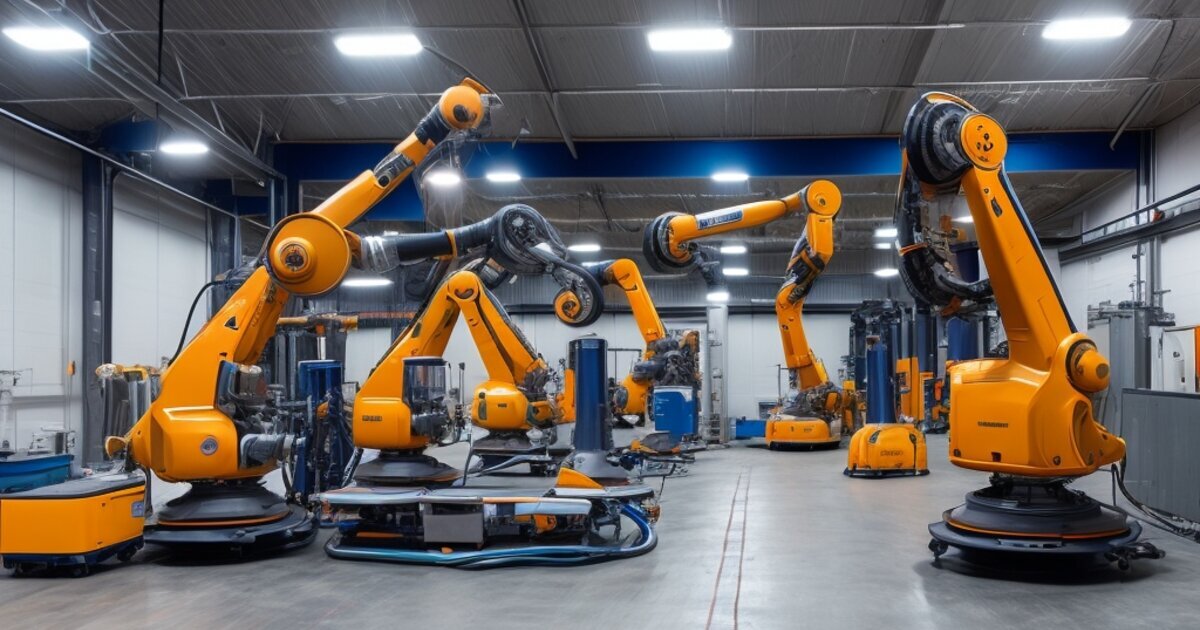
Painting automation moved from pilot-stage curiosity to mainstream capital planning in 2026. Facility managers, operations leaders, and industrial engineering teams are now expected to evaluate robotic coating lines with the same rigor they apply to HVAC replacements, process equipment upgrades, or plant expansion projects. The challenge is not finding options. The challenge is choosing a platform that fits your production mix, quality standards, labor model, and risk tolerance.
This guide compares leading painting robot brands through an owner-operator lens: what each platform does well, where implementation friction appears, and which decision criteria matter most when you are accountable for uptime and return on investment.
Quick Answer
The top painting robot brands for 2026 are ABB, FANUC, Yaskawa Motoman, Kawasaki, and Durr. Facility teams should choose based on production fit, finish-quality requirements, local service coverage, commissioning risk, and total lifecycle cost rather than arm speed or purchase price alone.
2026 Robot Selection Workflow
<line x1="220" y1="64" x2="250" y2="64" stroke="#6b7f8c" stroke-width="2"></line>
<line x1="450" y1="64" x2="480" y2="64" stroke="#6b7f8c" stroke-width="2"></line>
<line x1="680" y1="64" x2="710" y2="64" stroke="#6b7f8c" stroke-width="2"></line>

<rect x="300" y="138" width="320" height="56" rx="10" fill="#f2a23d"></rect>
<text x="460" y="170" text-anchor="middle" fill="#fff" font-size="16" font-weight="700">Deployment Decision With Lower Risk</text>
What Changed in 2026
The 2026 market is less about headline specs and more about integration maturity. Most top brands can deliver strong path accuracy and repeatability on paper. The differentiator now is how quickly you can get from mechanical install to stable production.
Three shifts are shaping buyer decisions this year:
- Programming speed is a hard ROI variable. Teams increasingly value offline programming workflows, digital twins, and template libraries because commissioning delays wipe out expected labor savings.
- Data visibility matters more than brochures. Plants want real dashboards for transfer efficiency, cycle time variance, and booth utilization, not static post-run reports.
- Service access is a strategic constraint. For Southwest operations, downtime cost can outrun hardware cost. Local parts inventory and response times now influence procurement scoring.
If your evaluation matrix still overweights arm speed and underweights support model, you are likely underestimating lifecycle risk.
Brand Comparison: 2026 Snapshot
| Brand | Best Fit | Main Strength | Procurement Watch-Out |
|---|---|---|---|
| ABB | High-mix production and complex geometry | Digital workflow and integration maturity | Higher capex and controls learning curve |
| FANUC | Uptime-focused facilities | Broad service familiarity and reliability | May need strong integrator support for custom cells |
| Yaskawa Motoman | Mid-size facilities scaling automation | Balanced cost and dependable motion control | Setup quality depends on application engineering |
| Kawasaki | Heavy industrial components | Ruggedness and repeatability | Less streamlined for first-time robotics teams |
| Durr | Enterprise paint systems | Finish consistency and closed-loop process control | Scope and cost can expand quickly |
ABB
ABB remains a premium choice for facilities that prioritize process consistency and advanced integration. Its ecosystem is strong in multi-robot coordination and digital workflow maturity, which can reduce commissioning drag on large projects.
Best fit: High-mix lines, complex geometry, and teams with strong controls engineering support.
Watch-outs: Higher initial cost and a steeper learning curve for teams without dedicated automation specialists.
FANUC
FANUC keeps its reputation for reliability and broad integrator familiarity. For many owners, FANUC is the lowest-friction path because local technicians, parts channels, and trained programmers are easier to source.
Best fit: Facilities that value predictable uptime and easier staffing for maintenance/programming roles.
Watch-outs: In highly customized finishing cells, some teams report longer optimization cycles without strong integration partners.
Yaskawa Motoman
Yaskawa is often selected when teams need a balance between cost discipline and dependable performance. Motion control quality is strong, and the platform is widely used in industrial environments with moderate-to-high duty cycles.
Best fit: Mid-size facilities scaling from manual to semi-automated coating workflows.
Watch-outs: Performance depends heavily on application engineering quality during setup.
Kawasaki
Kawasaki continues to show value in heavy industrial contexts where ruggedness and repeatability matter more than polished software ecosystems. Teams with in-house automation experience can extract excellent value.
Best fit: Heavy fabrication, energy infrastructure components, and larger part handling requirements.
Watch-outs: User experience and workflow tooling can feel less streamlined for teams new to robotics.
Durr
Durr remains a top-tier option for highly integrated paint systems and enterprise-grade process control. It is often shortlisted where finish consistency and closed-loop production management are critical.
Best fit: Large-scale programs with strict quality tolerances and planned long-term automation roadmaps.
Watch-outs: Project scope can expand quickly; governance and change control must be tight.
How Facility Managers Should Evaluate Vendors
Technical specs alone do not decide success. The winning vendor is usually the one that aligns with your plant constraints and operating model.
1) Validate Throughput Under Real Conditions
Ask for proof against your actual part mix and coating system. A benchmark that looks excellent on uniform demo panels may not hold when you introduce changeovers, masking requirements, or variable cure windows.
Request pilot data that includes:
- Cycle-time variance by part family
- Rework percentage across at least two production weeks
- Transfer efficiency at different booth loads
- Film thickness consistency by edge and corner zones
2) Quantify Commissioning Risk
Many projects miss business targets due to schedule slippage, not robot failure. Insist on a commissioning plan with named responsibilities, integration milestones, and acceptance criteria.
Key documents to require:
- FAT and SAT protocols
- Contingency timeline for controls issues
- Operator training matrix by role
- Escalation tree for startup defects
3) Score Service Infrastructure
Support model should be a weighted scoring category, not an afterthought. In high-temperature Southwest markets, downtime windows can be expensive during peak production months.
Evaluate:
- Nearest certified service coverage
- On-hand spare parts expectations
- Contracted response times by severity level
- Remote diagnostics capabilities and limits
4) Model Total Cost of Ownership
Capex comparison is easy. Lifecycle cost comparison is what protects your budget. Include training refreshes, software licensing, preventive maintenance, and expected part replacement intervals.
When possible, run a 5-year scenario model with low/median/high utilization assumptions. This makes sensitivity risks visible before procurement approval.
Common 2026 Buying Mistakes
Even experienced teams repeat predictable errors when robotics enters capital planning under deadline pressure.
- Choosing by sticker price alone. Lower upfront pricing can hide expensive integration or support gaps.
- Underestimating data requirements. If your team cannot capture and act on process data, quality drift becomes harder to catch.
- Skipping operational readiness. A robot cell cannot outperform a process that lacks SOP clarity, preventive maintenance discipline, or workforce adoption planning.
- Ignoring consumables strategy. Coating viscosity control, nozzle maintenance, and filtration schedules can undermine expected efficiency gains if unmanaged.
Recommended Shortlist Strategy
For most commercial and industrial coating programs, a two-tier shortlist performs better than a broad beauty contest.
- Tier 1 (fit and feasibility): narrow to 2-3 platforms that meet production and support thresholds.
- Tier 2 (commercial and execution): compare integration plan quality, risk ownership, and lifecycle economics.
This structure avoids spending weeks debating marginal technical differences between vendors that are not viable for your operating context.
Implementation Roadmap for Southwest Facilities
If you are deploying in Arizona, Nevada, New Mexico, or surrounding markets, climate and staffing realities should shape the rollout sequence.
Suggested roadmap:
- Start with a contained process area where quality measurement is straightforward.
- Run a stabilization window before expanding robot utilization targets.
- Build a local spare parts and training cadence before scale-up.
- Tie robot KPIs to production, quality, and maintenance dashboards used by existing teams.
This phased approach usually beats big-bang launches for facilities balancing daily output with transformation work.
Facility Manager Checklist
- Define acceptance metrics before vendor demos: Specify cycle time, transfer efficiency, rework ceiling, and thickness tolerance so all proposals are measured equally.
- Require a commissioning responsibility matrix: Identify who owns controls integration, safety validation, SOP updates, and operator signoff.
- Audit support capacity in your region: Verify local technician coverage, parts lead times, and emergency response commitments in writing.
- Model 5-year lifecycle cost scenarios: Include preventive maintenance, consumables, software, training refreshes, and expected downtime impact.
- Run a pilot with your coatings and geometry: Do not approve full rollout based only on lab or showroom data.
- Create operator adoption plan early: Train leads and maintenance staff before go-live to reduce post-launch drift.
- Schedule post-launch optimization reviews: Set 30/60/90-day checkpoints for data-driven tuning after startup.
Frequently Asked Questions
What is the best painting robot brand in 2026?
The best brand depends on your process. ABB, FANUC, Yaskawa, Kawasaki, and Durr are all strong options when their support model, integration approach, and lifecycle cost match the facility’s production needs.
How should a facility compare painting robot vendors?
Compare vendors using real part trials, acceptance metrics, commissioning plans, regional service coverage, spare parts availability, software requirements, and 5-year ownership cost.
Are painting robots worth it for Southwest facilities?
They can be worth it when throughput is consistent, labor constraints are significant, and support is available locally. A phased pilot usually reduces risk more than a full-scale first deployment.
Conclusion
In 2026, the best painting robot brand is not a universal answer. It is the platform that can deliver stable quality, predictable uptime, and manageable lifecycle cost in your specific operating environment. ABB, FANUC, Yaskawa, Kawasaki, and Durr can all succeed when matched to the right process and support model.
For facility teams, the practical advantage comes from disciplined selection and commissioning governance. When you pair technical evaluation with commercial risk control, robotics becomes a durable asset strategy rather than a one-time technology purchase.